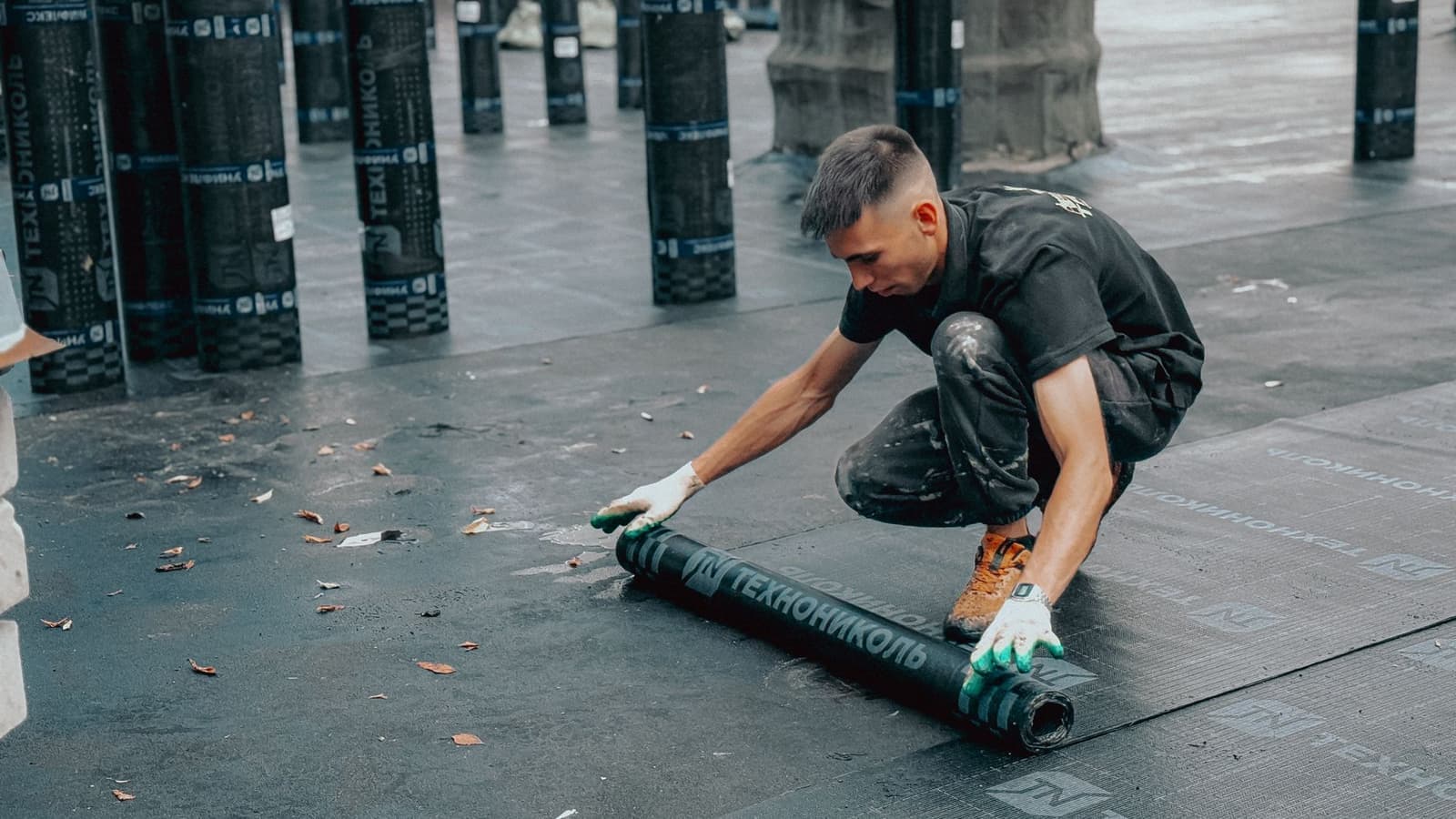
Flat roof replacement strips a low-slope roof and installs a new membrane over a prepared deck. TPO, PVC and modified bitumen all depend on well-made seams and sound drainage. The membrane is the covering, and the details around it are the weak points.
Seams and drains carry the weight
A low-slope roof sheds water slowly, so every seam is tested by standing water. Seams are welded by heat or joined with adhesive, and their quality shows up over time. Drains, scuppers and edge metal take the water away, and they need to be sized and set correctly.
A good scope names the membrane, the seam method, the insulation board if any, and each drain and edge detail.
Membrane choices
TPO and PVC are single-ply membranes welded at the seams. Modified bitumen is laid in plies and can be heat-welded or cold-applied. Each has its own seam method, edge details and manufacturer instructions.
The choice depends on the building, the roof's exposure and what is already on the deck. The assessment shows which options fit.
What a flat roof replacement includes
- Removal of the old membrane and the layers beneath it
- Deck inspection, with damaged sections replaced
- Insulation or cover board where the design calls for it
- A new membrane with seams made by the stated method
- Drains, scuppers and edge metal set and flashed
- The permit and inspection for the address
Signs the membrane is finished
- Water that stays on the surface for long after a rain
- Seams that have opened or lifted
- Blisters, splits or soft spots underfoot
- Stains below that grow after each storm
How many layers, and when a coating is not enough
Where County rules apply, a new covering may go over an old one only when one layer is already there and the deck and framing are sound (LA County Public Works, BCM 1512, 1 Apr 2025). Laying new membrane over a worn one only postpones the work.
A coating is a different job. It gets a line of its own in the LADBS express permit bulletin (effective 1 Jan 2026): approved coatings over an existing roof. A coating suits a roof that is otherwise sound, not one with a failed membrane.
Energy values for low-slope roofs
The state energy code sets a stricter test for low slopes: an aged reflectance of 0.63 with 0.75 emittance, or an SRI of 75, in climate zone 4 and zones 6 through 15, once the work passes 50 percent of the roof (California Energy Commission, 2022 Standards). An insulation trade-off table gives another path.
For the City of Los Angeles, the LADWP sheet (2022) lists 0.65 and 0.85, or an SRI of 78, for residential low-slope roofs.
Questions about flat roofs
Who are the top TPO manufacturers?
A ranking of manufacturers would not tell you how a membrane will perform on your roof. The membrane's thickness, the seam method and the details at edges and drains matter more, and the scope should state all three.
How many layers can a flat roof carry before a tear-off?
Where County rules apply, one existing layer is the limit for placing a new covering over the old, and the deck and framing must be sound (LA County Public Works, BCM 1512, 1 Apr 2025). Past that, the roof comes off.
When does a coating stop counting as a replacement?
When the roof underneath is no longer sound. The coating item in the LADBS bulletin (2026) assumes a roof whose membrane and deck are still good. A failed membrane needs replacement.
Is torch down roofing illegal?
Torch-down is a heat-welded modified bitumen system. Whether open-flame installation is allowed at an address is a question for the permit office and the fire department, so ask them before the job is scheduled.
Do low-slope reroofs have to meet cool roof values?
Yes, in the listed zones, once work passes 50 percent of the roof (California Energy Commission, 2022 Standards). The values are higher than for steep slopes. The City of Los Angeles lists its own figures for residential low-slope roofs (LADWP, 2022).